
10 Ways Enterprise Architecture Enables Business Agility: Your Fast Track to Adapting and Thriving
Unlock your organization’s full potential with a nimble EA strategy.
In today’s rapidly evolving business landscape, agility is not a luxury—it’s a necessity. Enterprise Architecture (EA) can be the key to adapting quickly and seizing opportunities. Here’s how:
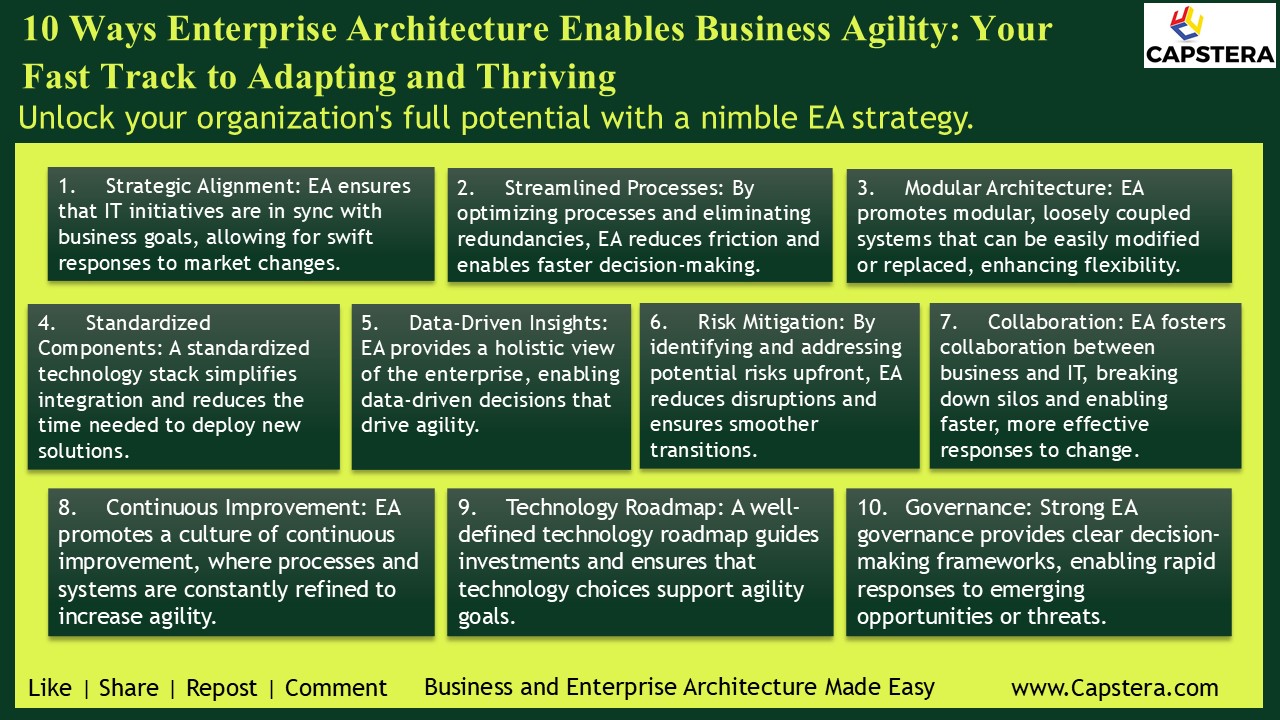
- Strategic Alignment: EA ensures that IT initiatives are in sync with business goals, allowing for swift responses to market changes.
- Streamlined Processes: By optimizing processes and eliminating redundancies, EA reduces friction and enables faster decision-making.
- Modular Architecture: EA promotes modular, loosely coupled systems that can be easily modified or replaced, enhancing flexibility.
- Standardized Components: A standardized technology stack simplifies integration and reduces the time needed to deploy new solutions.
- Data-Driven Insights: EA provides a holistic view of the enterprise, enabling data-driven decisions that drive agility.
- Risk Mitigation: By identifying and addressing potential risks upfront, EA reduces disruptions and ensures smoother transitions.
- Collaboration: EA fosters collaboration between business and IT, breaking down silos and enabling faster, more effective responses to change.
- Continuous Improvement: EA promotes a culture of continuous improvement, where processes and systems are constantly refined to increase agility.
- Technology Roadmap: A well-defined technology roadmap guides investments and ensures that technology choices support agility goals.
- Governance: Strong EA governance provides clear decision-making frameworks, enabling rapid responses to emerging opportunities or threats.
By embracing these principles, Enterprise Architecture can transform your organization into an agile powerhouse, ready to adapt and thrive in a dynamic business environment.